Benefitting from the boom
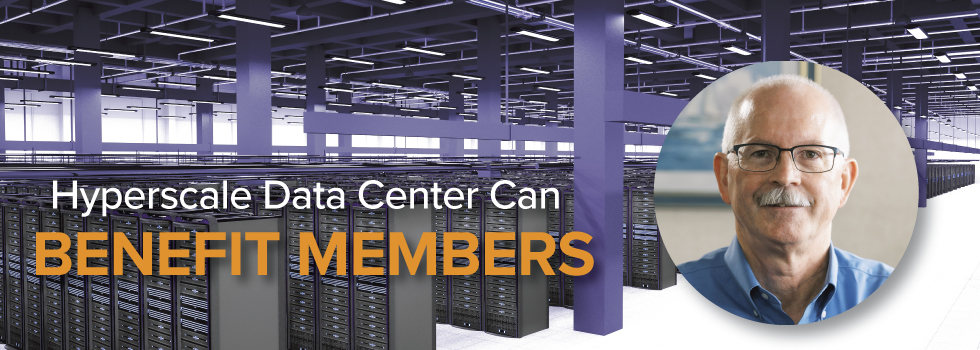
Walton EMC’s experience in serving a hyperscale data center can benefit members!
Data centers are the fastest-growing source of electricity demand in the United States, yet today they account for less than 6% of the nation’s total energy consumption — a share that is expected to double within the next few years.
Georgia is one of the fastest-growing data center markets in the nation, and the increased electricity demand they bring is coming whether Walton EMC serves them or not. UGA researchers estimate that additional data centers could increase Georgia’s electricity demand by 49% by 2030. By selectively partnering with the right projects, the co-op’s customer-owners can be at the front of the line to benefit from that growth rather than simply absorb its impact.
Every time you stream a show, check your email or scroll social media, a data center is doing the heavy lifting. Most of the processing behind the apps and websites you use every day doesn’t happen on your device — it happens at a data center. And as our reliance on those services grows, so does the demand for the facilities and the electricity that power them.
Driven primarily by the expansion of AI computing and cloud services, data center construction in the state is exploding, says Hudson Kingery, Walton EMC’s vice president of power supply.
“At the end of last year, Georgia had 63 active data centers, 35 under construction, and another 249 planned within the next five years,” he said. The majority of these are concentrated in the greater Atlanta metropolitan area, but data center developers are increasingly looking across the state.
Powerful needs
Their need for power is the key reason Big Tech — Amazon, Google, Meta and Microsoft — are developing data centers in Georgia. Through long-range planning, Georgia utilities have developed robust electricity generation and transmission infrastructure.
“These hyperscale data centers use very large amounts of energy,” Kingery said. Data centers typically consume 10 to 40 times more electricity per square foot than standard commercial buildings, reports a new University of Georgia (UGA) study.
Georgia law allows certain large-scale electricity users — including manufacturers, distribution centers, most schools, grocery stores and data centers — to choose their electricity provider.
“Some utilities are dealing with Big Tech for the first time, but we’ve been at this since 2017,” Kingery reminded.
What’s in it for you?
A proven track record serving the Meta project positions Walton EMC to selectively capitalize on the boom.
“We can choose only the opportunities that bring financial benefits to our existing members without compromising the reliable, affordable power they depend on,” Kingery said. Those potential benefits include the the ability to maintain affordable electric rates.
“These data centers can generate significant, predictable revenue that helps stabilize rates for traditional Walton EMC members,” Kingery said.
Hyperscale data centers are being required to pay for the electric infrastructure upgrades needed to serve them — things like new or improved transmission lines and substations. Those investments also strengthen the grid for our existing members.
The bottom line
Whether Walton EMC will serve any of the newcomers will be determined on a case-by-case basis. But the criteria will always be the same, Kingery assures.
“Our approach goes beyond a typical cost-benefit analysis,” he said. “First, we make sure the data center covers the costs associated with service to them. Then, we make sure there’s a clear benefit to the rest of our membership — while carefully minimizing risk for our traditional members.”
Archives
See all Archives
Connect With Us
Media Contact

Savannah Chandler
Manager of Communications
marketing@waltonemc.com
770.266.2408
Contact Us
Contact Us
Call 770.267.2505 to speak to a Customer Care Representative from Monday through Friday,
7 a.m. – 7 p.m.