Decades of Innovation: 1970s
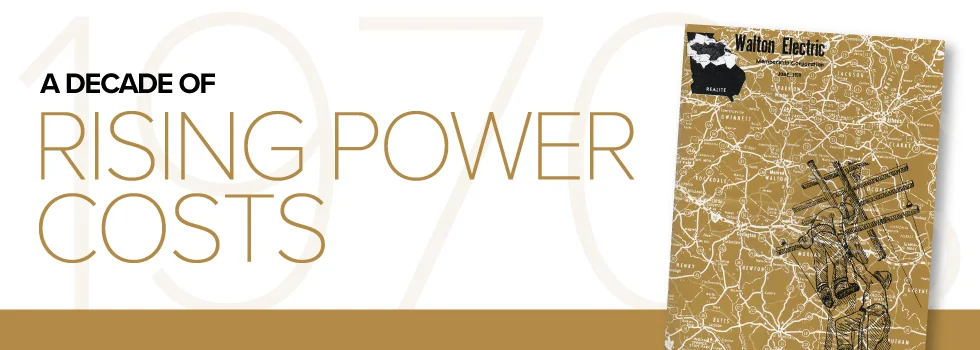
During the 1960s — what some called the “Golden Age” of electric utilities — Walton EMC members experienced steadily declining power costs. The 1970s experienced the opposite.
Price shock
The 1973 Arab oil embargo triggered energy shortages and skyrocketing prices. This spike rippled throughout the economy and affected electricity costs. While the embargo was the dominant factor, it wasn’t the only reason costs were rising. New environmental regulations for existing coal plants and costly new safety requirements for nuclear plants under construction drove up costs.
Also, a surge in residential and commercial construction increased electricity demand. High interest rates further increased the cost of financing new power plants needed to meet that demand.
Power generating companies, like Georgia Power imposed wholesale rate increases on co-ops which were ultimately passed on to our consumers. From 1972 to 1974, the wholesale rate to EMCs doubled.
Taking matters into their own hands
It became obvious that Georgia’s EMCs needed to gain control over their power supply. Georgia Power needed cash and was eager to sell some of their assets, creating a golden opportunity for the co-ops.
In 1974, 39 of the state’s EMCs formed another co-op called Oglethorpe Power Corporation (OPC). OPC helped purchase and operate parts of Georgia Power’s generation plants and transmission lines on behalf of the EMCs.
Protecting co-op territory
In 1973, the Georgia Legislature passed the Territorial Act. This law prevented costly duplication of power infrastructure and stopped other utilities from poaching territory and loads from the co-ops.
Peak demand
Co-op members became familiar with the term “Peak demand”. Walton EMC started programs like “Watt-Wiser” and “Switch/Save” to educate members and give them the tools to help combat rising prices. Despite the turmoil, the cooperative’s principle of service to its members remained constant.
Archives
See all Archives
Connect With Us
Media Contact

Savannah Chandler
Manager of Communications
marketing@waltonemc.com
770.266.2408
Contact Us
Contact Us
Call 770.267.2505 to speak to a Customer Care Representative from Monday through Friday,
7 a.m. – 7 p.m.